IVF & MOET Services
In-Vitro Fertilisation (IVF) and Multiple Ovulation Embryo Transfer (MOET) are two methods of producing embryos from elite donor females with the purpose of enhancing the number of calves produced from that female in a short period of time. Edward has completed extensive training and gained a vast level of experience in multiple countries in both methods of embryo production. He has been a pioneer in Ovum Pick Up (OPU) in Australia and leads the embryo services offered at Repro Hub.
IVF
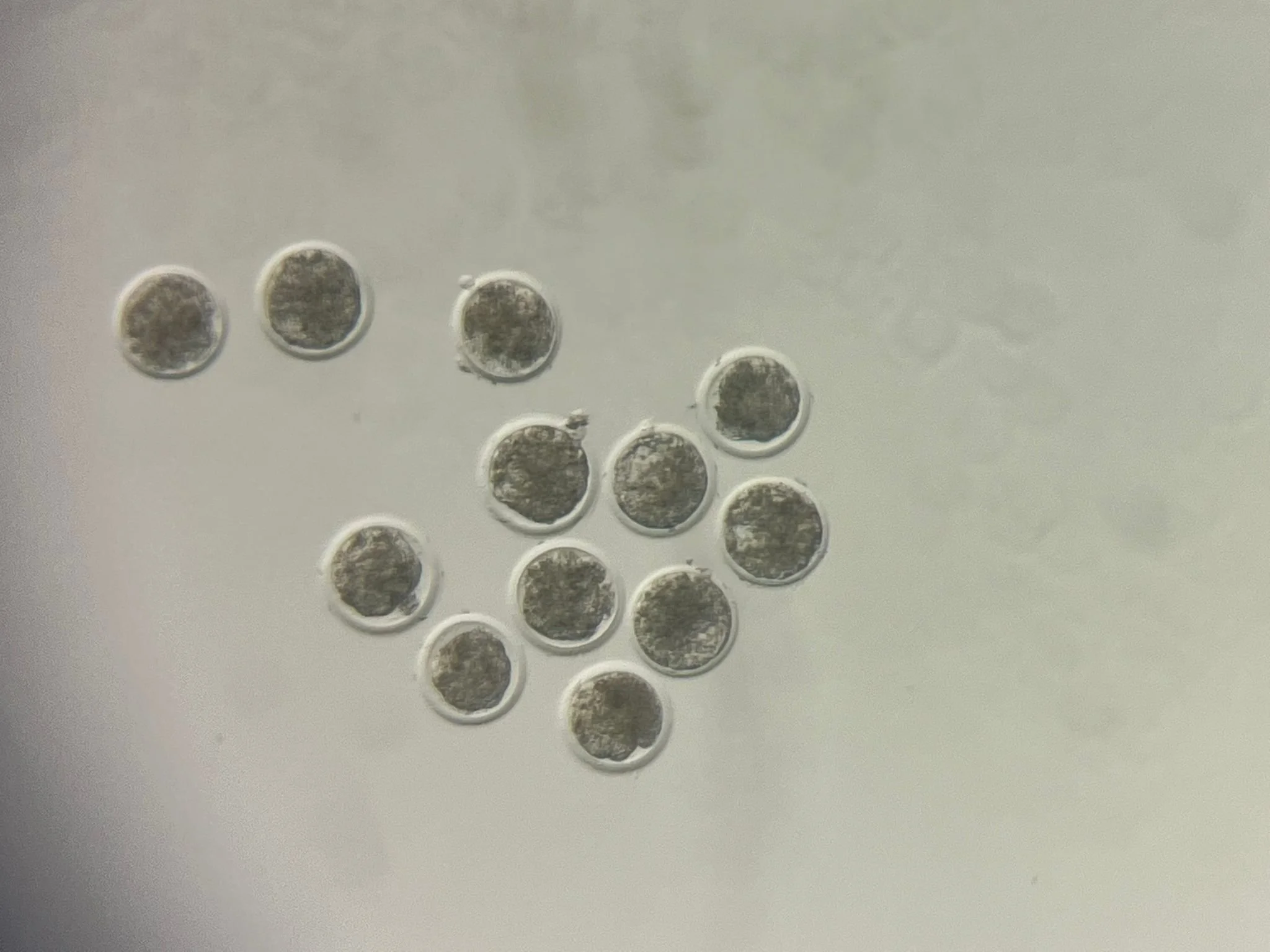
In order to produce IVF embryos, oocytes are collected from the ovaries of the donor cow via ultrasound-guided needle aspiration. The oocytes are isolated from the collection sample by an embryologist and then transported to a laboratory. Here, they are fertilised with semen from a sire of your choice and through a number of steps and rigorous quality control, are returned to the producer, either fresh or frozen, as a 7 day old embryo ready for implant into a recipient female.
MOET
Also known as “conventional” embryo production, MOET involves the use of endogenous hormones to synchronise the oestrus and superovulate the ovaries of the donor cow. The cow is artificially inseminated with semen from a sire of your choice and 7 days later, the uterus is flushed to retrieve any embryos that have been made. The embryos retrieved are graded and assessed for their viability before being either transferred fresh into recipient females or frozen for transfer at a later date.
How many straws of semen are needed?
For IVF, a single straw of semen is enough to fertilise the oocytes from multiple donors.
MOET requires the use of two straws of semen. When displaying oestrus, the cow is inseminated twice, 12 hours apart.
Can I collect embryos from a heifer?
Yes, both methods of embryo production can be carried out on heifers. IVF embryos can be produced from females as young as 6 months of age, where a greater level of sexual maturity is required for those collected via MOET.
Can embryos be collected while my cow is pregnant?
The OPU process for IVF production does not enter the uterus, so females can be collected as soon as two weeks after calving and up until 100 days of pregnancy.
A female cannot be pregnant for MOET production and it is recommended that she have calved a minimum of 8 weeks before beginning the process.
How many donors would you like to collect?
Has the donor had a calf previously and if so, how long ago?
Is the donor pregnant?
How often can a donor be collected?
Oocytes for IVF embryo production can be collected at two weekly intervals from donor females.
The turn-around time for MOET programs is a minimum of 5 weeks to allow sufficient time for the synchronisation and superovulation hormone process, and a rest period in-between programs.
Where do you offer these services?
Repro Hub offers housing for donors for both methods of embryo production. IVF collections are run once a month and donors can be brought in on that day for collection and go home within a couple of hours. Alternatively, they can reside here for multiple collections.
MOET programs are run on demand and donors can reside here for the 3-5 week process, or stay for multiple programs.
Alternatively, both methods of embryo production can be done on-farm. We do have a minimum number of donors required in order to do IVF collections on-farm though.
Have you got previous experience with embryo programs?
What is the reproductive history of the donor?
When considering on-farm collections, what facilities are available?